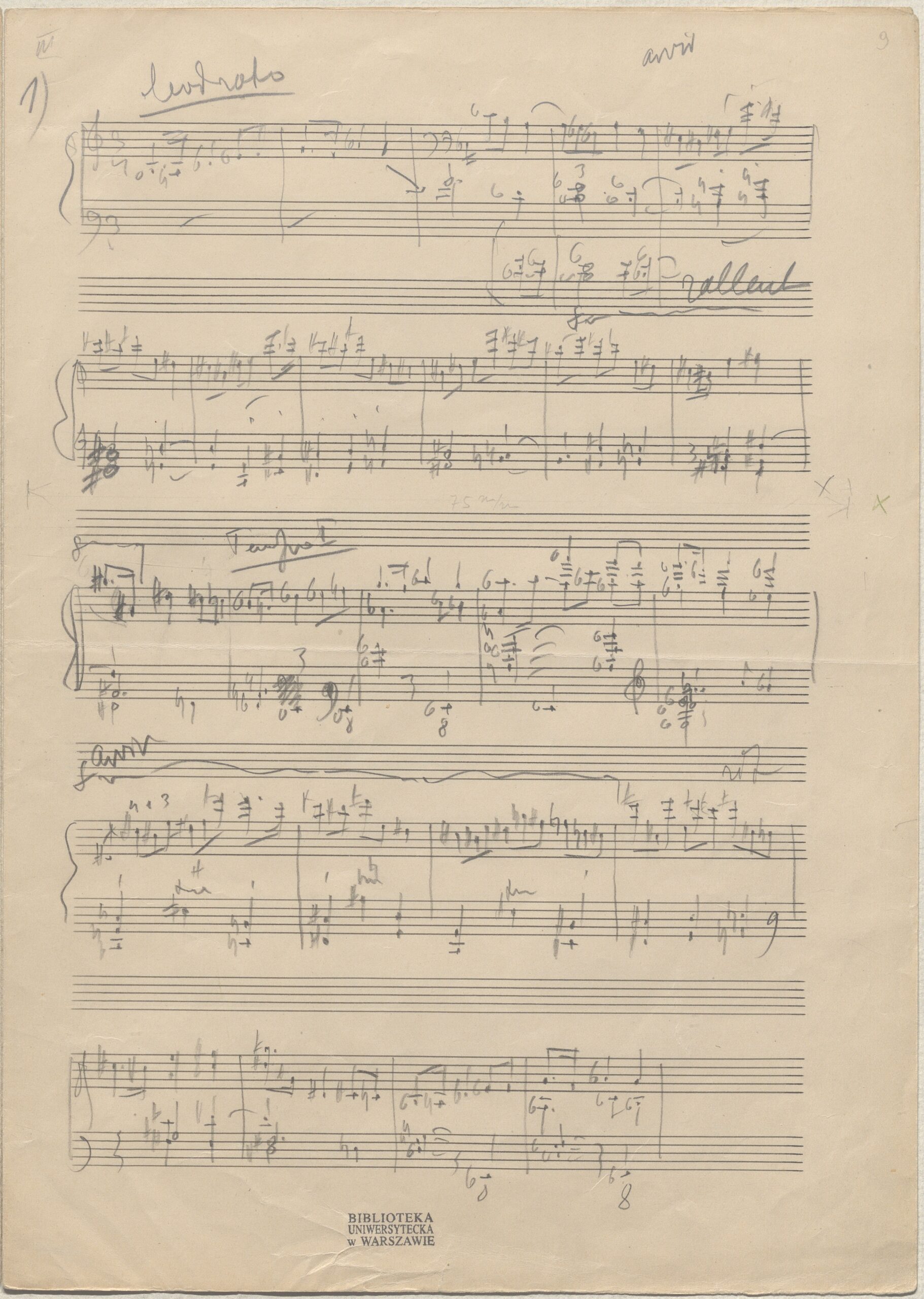
Of Karol Szymanowski’s three mazurkas, only two remain – at least officially. In 1933–1934, the composer was working on his final opus, Op. 62, but only two of the miniatures were published. The third lay in the archives for years, surviving only as fragments pencilled onto sheets containing sketches for the other two. Szymanowski did not make matters easy for posterity: he wrote quickly, for his own use.
The material for Mazurka No. 3 was discovered and edited by Elżbieta Jasińska-Jędrosz, who spent decades studying the composer’s manuscripts. In 2023, the fragments were published by PWM publishing house. Yet even a musical score reconstructed with the utmost care did not amount to a finished composition. The entire opening section had survived, along with much of the middle section and a fragment of the return to the opening material. What was missing, however, was the ending.
Similar dilemmas confronted those who completed Mozart’s Requiem and Puccini’s Turandot, or reconstructed Mahler’s Symphony No. 10. In the spaces between the surviving notes and the finished work, where different creative worlds overlap and shine through one another, someone must decide how the material should be ordered, developed and brought to a close. And that is where the question of authorship becomes problematic.
At the initiative of pianist Joanna Domańska, Mikołaj Piotr Górecki took on the task. The composer had already completed music by another composer: his own father, Henryk Mikołaj Górecki. As he himself acknowledges, that task had been easier. This time, the first challenge was to establish the order of the fragments and assemble them into a convincing whole. Górecki resolved not to introduce any musical motifs of his own, but Domańska, who was to record the mazurka, felt that the linking passages were too similar to one another. She therefore supplied three of her own and reinstated four bars that Szymanowski had crossed out. Whether he had rejected them for good or merely set them aside for later remains unknown – and unfortunately, the composer himself is no longer available for consultation.
Górecki’s coda, constructed from Szymanowski’s motifs, brings the work to a gentle close over a sustained open fifth. Domańska hears it as a farewell. The mazurka now comprises 85 bars, 66 of which are Szymanowski’s, and lasts approximately three minutes. It thus has three authors, although one of them had no say in the work’s final form.